Monday, October 12, 2015

Savage Empire: Opening Thoughts

And now for something a little different.

One of the trademarks of the Ultima series is the fact it uses a new engine for each main entry in the series. Some are less visibly dramatic than others (compare the difference in look and feel between Ultimas IV and V, as opposed to those between V and VI), but every numbered entry used a new engine and pushed it to its limits. That didn't keep those engines from being reused, however - Ultima VII's was re-used for Serpent Isle, and Ultima VIII's would be refined and reused for Crusader. The practice of using an existing engine to power an entirely new game started here, though, with Savage Empire's use of Ultima VI's engine to weave a pulp fiction tale of a lost valley.

The opening credit scroll is very nicely done.
Released in 1990, mere months after Ultima VI itself, Savage Empire was the first in a sadly short-lived spin-off series, giving the Avatar further adventures outside of Britannia. While having little to do with the main series, being only tangentially related at best, they're referenced enough by other games that it's fair to accept them as canonical. This first entry transplants the Avatar from the medieval-esque world of Britannia into the Lost World-style Valley of Eodon, populated with numerous and varied tribes, prehistoric beasts, and dinosaurs.

My previous experience with Savage Empire isn't particularly extensive. I've mentioned before the problems that I've had in the past with Ultima VI's engine, and the fact Savage Empire is basically that with a new coat of paint didn't help with my enjoyment. In addition, while it's neat to see the series' take on other genres, I'm not overly fond with the lost world-type stories. I mean sure, I had something of an interest in dinosaurs when I was a kid, but as a genre... eh. I'm not sure why it's never really clicked that well with me - and that's not to say that I don't enjoy a well-told story in that style either - but that coupled with the fact that steampunk very much is a genre I like, and, well, I always found myself favoring Martian Dreams over Savage Empire when I got the hankering to give the Worlds of Ultima games a whirl. But while the game itself hasn't held as much interest for me as compared to its subsequent entry - the manual. 

Oh man, the manual.

Virtue test time! Again!
Savage Empire's manual probably stands rather high on the list of utterly unique approaches for a game manual, if not topping it outright. Rather than simply lay out the facts, not only does the manual follow the grand Ultima tradition of doing so in an in-universe fashion, it does so by means of presenting it as a pulp adventure magazine that wouldn't be out of place in the era the game is attempting to evoke. And while the stars of the show are the introduction of the backstory as the first part of a serial penned by the Avatar himself (which incidentally is the source for my personal headcanon that the Avatar makes his living between adventures by publishing tales of them), and Dr. Rafkin's descriptions of Eodon's people, flora, and fauna, it's in the detail work that the manual really shines. From hints cleverly disguised in the Letters to the Editor to throwing the developers into a rather amusingly written expedition to advertisements for Jimmy Malone's notebooks and Savage Empire T-shirts (the latter of which actually existed), the manual, as any good manual should, sets the tone and mood of the game excellently. I pored over it gleefully as I prepared to fire up the game, suppressing squeals of glee at the little linguistic tidbits Rafkin delivers on the language of Eodon and the dialects of the varying tribes. (Because of course I would.) And I can't help but bring attention to the copyright information right on the table of contents page: "Reproduction without permission is strictly prohibited, and punishable by sending a Tyrannosaurus Rex to eat your mother... do people really read this fine print?"

Yes, author of said fine print. Some people do, and they are amused.

Last order of business was character creation, and I'll admit it was nice to take another virtue quiz of sorts, albeit much abbreviated and modified slightly to stick with the theme. Only three questions this time around, and they're phrased to feel more 'tribal' than medieval, but it's good to see that the game continues the tradition of basing initial parameters for the player character by a series of moral dilemmas. Presented as a dream sequence that may not actually be dream, Intanya says he is working to heal you, but needs to know your spirit in order to do so. He asks three questions - in Aric's case, he first asked whether he would disobey a chief's directive to fight alongside his companions, and he most certainly would. Next he asked about a warrior who borrowed another's spear, then did not return it. Upon finding said warrior's own misplaced spear, Aric chose to give it to the one owed the spear. And when forced to decide whether to uphold an oath and protect his chief or break it and honestly reveal him as a murderer, he chose the latter option.

So was Aric (and I with him) dropped into the Valley of Eodon, and so does a new adventure begin...


Friday, October 2, 2015

Linguistic Asides: The State of the Blog

With ten games in the main series, plus the two Worlds of Ultima games, plus the two Ultima Underworlds, and Akalabeth, that's fifteen games total. I've now made my way through seven, and though that's technically shy of halfway, finishing Ultima VI does feel like something of a turning point, as its completion marks the beginning of a detour, the Avatar's adventures apart from Britannia and the watchful eye of Lord British. As such, it feels like a good point to pause for a moment and reflect a bit on this wacky little adventure of mine.

This definitely isn't my first time attempting to play my way through the Ultima series in its entirety, and it isn't even my first time attempting to blog about the experience while doing so. I think the first time I tried to blog about it, I barely made it through Akalabeth, and was so dissatisfied with how it was shaping up that I scrapped the whole thing. And even this time around, it was something of rough going in the beginning - I'm not entirely sure why. Maybe part of it was because I still hadn't quite figured out my 'groove,' the particular style I wanted to approach the project, and maybe part of it was because there just didn't feel like there was a lot to say about the early Ultima games. That was a good portion of the reason I came to a screeching halt partway through Ultima I, in addition to my life getting busier than I'd planned on right about then. I felt like I didn't really have anything to say that wasn't just reiterating what happened in-game, and so I set it aside for a time until I could figure out what to do with it.

The hankering to play Ultima again came before I really figured that out, though, and it didn't feel right doing so without starting up the blog again. So I did - I still had my old save file kicking around, so I threw out a brief 'I'm back' sort of post, fired off a quick email to the Ultima Codex about much the same, and played.

I think that's about when things shifted.

Thanks to WtF and the Codex, I found myself with something of an audience. And that helped - knowing someone was actually paying attention gave me a bit more motivation to keep things up. I think I hit my stride somewhere around Ultima II, or at least I felt like I had a better grip on how to approach things. I think a lot of that had to do with the fact there were a fair few things about Ultima II that didn't quite sit right with me, which gave me fodder for things to talk about besides simply my exploits in the game. The further along I've got, the more verbose I feel I've become, partly because the games have gotten larger and more complicated, and partly because I feel more confident in both my scrutiny and my expression of what conclusions I draw.

And that's what it comes down to, really. I find I play the games differently than I used to, partly because I know I'm going to be blogging about it later, so I consciously look for moments that would be worth examining further, expanding upon. I read books differently now that I'm a writer, I watch movies differently ever since I spent a month in Rome with a film study program, and now, thanks to this blog, I find I play games differently, too. And it's kind of neat to look at something I've enjoyed for so long through different eyes, actually taking the time to peek past the veil and figure out what makes them tick as a narrative experience, poke and prod at them and figure out what works and what doesn't.

And ultimately, I think that's the biggest thing I've pulled out of this blog. I enjoy this sort of thing. Yes, I'm a writer, and I love crafting stories, planning them, spinning them, weaving them, but more than that, I love talking shop, as it were. Examining, analyzing, teasing out the tricks of the trade and recognizing when techniques work and when they fall flat - and not just the what and the how, but the why. There's dozens of things I could talk about outside of Ultima in that vein. What the movie War Horse taught me about the uses of negative space in a story. How powering my way through Planescape: Torment in a couple days helped me cope with the death of my grandmother. How I managed to pinpoint the killer in an episode of Castle from his first appearance on screen, before I even really knew who the character was, based entirely on how they chose to frame the shot. The longest 150-page book I ever read that was so tedious and obnoxious I wanted to throw it out the window multiple times, the way a character's voice actor managed to make me seriously feel terrible about a small action in The Wolf Among Us, scads of other moments like these that I simply view differently than I might have once due to the time I've spent digging through the world of stories in all their forms. And it's nice to have a platform to muse on these sorts of things, maybe even spark a little conversation in the process - I know I've enjoyed the ones I've had as a part of Spam Spam Spam Humbug (another something that I might never have actually done if I hadn't started this crazy venture in the first place).

So that's where my brain is at, now that I've made it sort-of halfway through the series. I figured I'd just make it through the canonical games, maybe poke through Lazarus or the Ultima 6 Project or one of the Neverwinter Nights remakes of Ultima IV when that was done, and call it good. Chalk it up as a fun little experiment and let that be that. But now I find myself wondering if it might be worth... expanding, down the road. There's a lot of other stories out there I'd like to experience and examine, whether for the first time or for the twentieth, from books to movies to TV to games. Maybe it's worth considering continuing in this vein once Ultima's done with.

I'm coming to discover this is something I love, after all. And being a guy who's currently between jobs, uncertain of exactly what sort of career I do want to have - well. Maybe having an outlet for something I've discovered to be a passion of mine is a good thing right about now.

Only time will tell, right? It's certainly inspired me in other ways - I've wanted to read through the Hugo/Nebula winners, watch the Best Picture winners... and for some reason I've had the germs of an idea for a fanfiction-y novelization of Ultima I bouncing around in my head lately. Maybe I'll spend NaNoWriMo hacking away at it?

In any case, I've learned a lot from this venture, and I look forward to seeing what more I learn going forward. And thanks for stopping by my little corner of the Internet - it's always easier to say your piece when you know someone's listening. Who knows - maybe at some point down the road, it'll be a little larger.

Thursday, October 1, 2015

Ultima VI: Closing Thoughts

Well that was a bit unexpected.

My side analysis of Gargish phonology wasn't even up a week before it became one of the most viewed posts I've tossed out there. Withstand the Fury Dragon's attempting to rope me into doing a segment based on it for the Ultima Codex's podcast sometime, which I'm more than willing to do - I mean c'mon, blather on about how TWO subjects I have a deep love for intertwine? (Although hold your horses, it's gonna be some time before I'm in a position to actually do so.) I, uh. I'm a little floored, to tell the truth - I wasn't anticipating that much interest at all, on account of the fact it was basically just me nerding out on a topic in my field, that happened to tie into Ultima VI. I'm half wondering if I can squint at Gargish hard enough to draw out enough for a follow-up at some point, now. There's a lot more I could go into as far as vowel quality goes (I never did touch on dipthongs), there's the point to make about why there are W's present in transcriptions of Gargish despite the fact there's no letter for it in the alphabet, and I haven't even attempted to see if I can figure anything out about Gargish prosody.

But we'll see what happens. For now, let's talk Ultima VI.

I was a bit worried going into the game, on account of the problems I've had getting used to the interface and the fact I'm going to have to deal with it for no less than three games on my list. But thankfully, I finally seem to have got over whatever hump had been there, and though a couple things still managed to trip me up (it took me way too long to figure out how to get the balloon to do what I wanted, and I can't tell you how many times I hit H to <H>ole up and Camp instead of R to <R>est) they weren't as debilitating as previous attempts at Ultima VI have been.

I didn't feel adequately prepared for encounters like this.
I enjoyed the game a lot more than I expected to as a result, though it still hasn't surpassed Ultima IV as my favorite (sorry, WtF). Frankly, I'm still undecided if it overtakes Ultima V, either. And I can't quite put my finger on why, either. i think some of it has to do with the combat curve in the game. Combat's a constant, regular presence in Ultima IV and Ultima V, giving the player ample opportunity to learn the ins and outs of the system before throwing them to the wolves in the tougher fights, and though this doesn't necessarily make the early fights less dangerous (and potentially frustrating), these early fights don't really set you back terribly much if you fall in battle while you're still getting the hang of the system. Maybe it means a trek back to where you were, a loss of experience or hard-earned gold or food, but it's not debilitating enough to necessarily demand a full-on reset.

Ultima VI's curve, however, is a bit more... erratic when it comes to its fights. I spent most of the first act of the game starved for combat, only brushing up against the occasional small band of brigands or unusually feisty rats along the roads of Britannia, apart from the battles to retake the Shrines. Though part of the reason I actually took the time to fight the Gargoyles at the Shrines was for narrative purposes (the reveal that comes with translating the tablet feels more poignant to me if there's actually been confrontations where death is on the line), I can't deny a good portion of it was also just for the experience. The majority of the fights I had up until seeking out the pirate map were with Gargoyles at the Shrines, or at least it certainly felt like it. And though they were no cakewalk, I don't feel they quite prepared me for the resource management that I needed to deal with when it came to the dungeons. I can only imagine how much moreso I would have felt if I hadn't transferred my character over, with the boosted stats and experience that came with the action. Maybe this was by design - the game is about resolving matters peacefully, after all, and admittedly, the fact that there's only one fight that I can think of that's strictly necessary (the hydra blocking the secret door in Sutek's castle) is a point in the game's favor in my mind. Still, the learning curve feels a bit sharp in this respect, and skewed a bit.

It's nice to know just what my magical resources mean.
Despite what problems in the past with the interface and some of the difficulties I had with the pacing of combat encounters, though, there's a lot about the design and engine of Ultima VI that I rather enjoyed. Streamlining the magic system a degree - making it so I didn't have to mix reagents and could easily see how many times I could cast any given spell with my current resources - made it a bit easier to use, and therefore a tool that I was more apt to use, and indeed used profusely. I've made my appreciation for the design of the Gargoyle realm rather obvious by this point, I think, though I haven't given enough credit to the design of the Gargish shrines yet - whether it's the numerous levers that control the gates at the Shrine of Control, the fires of the Shrine of Passion, or the meticulous scouring of a space for a secret door at the Shrine of Diligence, each shrine is very much a reflection of the principle it's designed to embody.

Inventory management became a bit cumbersome here and there, but there were some facets of it that I truly enjoyed - most notably the fact that gold coins actually had weight that had to be accounted for. Granted, it's probably easier on the player and less obnoxious to simply take money out of the equation when it comes to the decisions including weight as a game mechanic lead a player to make, but it works rather well here in Ultima VI. Including their weight in player carrying capacity forces a player to make decisions about their budget, more than just 'how much do I need to save before I can buy this really cool item.' The economic system in place in Ultima VI is balanced well enough to make such a thing possible without becoming too headache-inducing, and I really like it for some reason. Seems rather more reasonable to me than carrying around thousands and thousands and thousands of metallic coins - I hauled around enough boxes of coin when I worked at a credit union to know those things get dang heavy.

Little moments like this add so much flavor to the characters.
And Ultima VI's NPCs are the most memorable yet, and not just due to their unique portraits. Each and every one of them has a personality, even those who don't really have much to contribute to the plot, or even much to say at all. Blind, mute, injured, drunk, helpful, abrasive, energetic, lethargic - Ultima VI's cast runs the gamut, and every piece of dialogue they have to say color them further. And this includes their 'I don't know about that' responses when they're asked about something they don't have a response for - they're all unique, and they serve to give each character that much more flavor. Some ignore the question, some don't hear it, some dismiss it as unimportant, some apologize for not being of more help, but whatever they do, it's a telling portion of their character that future games in the series just can't really capture, on account of having switched over to the keyword system by them.

As always, though, I've got to get to the story sooner or later. And while I normally separate my discussion of the game's story into the story on its own and the story as it relates and fits into the story of the series as a whole, I'm not so sure I can make that separation as cleanly this time around. So much of Ultima VI's story leans on themes and ideas from previous games, after all. And perhaps partly because of that - the fact that it built upon the foundation the previous five games left for it - it's an extremely strong and well-woven story. In fact, despite my love for Ultima IV, I'm going to go as far as to say that Ultima VI is the pinnacle of storytelling in the entirety of the series.

Yes, I did really just make that claim.

The reason I say this is because Ultima VI's themes permeate the entirety of the game, from the overt to the subtle. Not only does it establish its own themes, but it builds upon the themes from the previous entries in the Age of Enlightenment while setting up others for further development later in the series. It's well-paced, even with the occasional potential short-circuiting from possibly asking characters such as Sin'Vraal and Naxatilor about certain topics too soon. Goals are clear and spaced well throughout the course of the story, and uses every tool at its disposal to reinforce its ideas and themes. I've already mentioned Ultima VI's use of contrast to display both the differences and the similarities between humans and Gargoyles, but there's far more to discuss when it comes to just how well-executed Ultima VI's story is.

I've mentioned before that the three games of the Age of Enlightenment establish the heart of the setting that Ultimas I-III introduced and refined. They're the games that explore the philosophy and way of life of the people of Britannia, and that's all culminated here in Ultima VI. Ultima IV introduced the virtues in the first place, a set of ideals that established a personal code of living. And that was the Quest of the Avatar was, at its core - a personal exploration of virtue, and an emphasis on the individual. From a certain perspective, it could even be argued that the Britannian system of virtues almost emphasize the individual - introspection, self-betterment, and the boundless infinity of wisdom to be gained from walking that path.

Ultima V took these virtues and examined the flipside of them, the way they could turn dark when twisted to become something they weren't. The game took a look at what happened when virtue became mandate and law rather than something willfully chosen and followed, and suggested a need for nuance and care when it came to application of the virtues. In a sense, this also reinforced the individualistic nature of the path of the Avatar - forced application on a larger scale led Britannia not into a golden age of development, but a dark period of tyranny, and it was the corruption of virtue in one man, Blackthorn, that cascaded down into an oppressive regime that held the kingdom in an iron grip.

Virtue is personal - but we can't forget those around us, either.
Ultima VI takes both of these central themes and turns them on their head, by way of its own central premise. If Ultima IV was about personal virtue, and Ultima V was about the dangers of mandating it by law, then Ultima VI is ultimately about virtue colliding with virtue. It's a story of culture clash, of what happens when differing viewpoints run up against each other, of the friction that can come out of it and of the fact that reconciliation can happen. Ultima IV established personal virtue, culminating in the precept of Infinity, the countless potential that flows out of personal application of the virtues, but Ultima VI brought in a system that culminated in Singularity, the upholding of unity and cooperation - and by means of its ending, recognizes both the importance of the individual and of a society. Ultima V explored the other side of the coin and revealed it to be dark and unpleasant, but Ultima VI proved that sometimes the other side is simply a different sort of virtue, that sometimes, both sides can be in the right, and that one side of a situation being good and reasonable does not always preclude the other side from being so as well. It introduces other virtues, suggests more nuance to the virtues of Ultima IV, and in so doing sets the stage for the theme of balance that permeates Serpent Isle. And it didn't always bludgeon a player upside the head with these, either - there's a lot of little hints at them from conversations the player may not even necessarily have. It's a tight narrative, it's unique in both theme and execution, and it's brilliant.

There's aspects of Ultima VI that I'd love to see expanded - a fan-made game from the Gargoyles' perspective would be utterly intriguing, if you ask me, running around the collapsing Gargoyle Realm to find an Orb of the Moons, figure out how it works, capture the Britannian Shrines, and ultimately figure out how to draw out the False Prophet - but there's no more and no less there than necessary to tell the story successfully, and that's what makes it work. It's ever-present, even in the detail work, and it doesn't drown you in the unnecessary. It's wonderful, and I'm glad that I've finally seen it through to the end.

It's been a journey well worth taking.

~~~

And now it's time to pull out my pith helmet and machete as I get ready to plunge into Savage Empire! I may have a few more general things to blather on about before I get started there, and in any case I've got a manual to read before playing, but Eodon is calling my name and I'm raring to answer the call.


Thursday, September 24, 2015

Ultima VI: The Best of Both Worlds

Unconvinced of my understanding of the Gargish way of life, the Shrine of Singularity had sent me on a pilgrimage to each of the other Gargish shrines, one dedicated to each of the three principles around which their philosophy revolved. I still had a few matters to attend to back in Britannia, but I figured it was best for me to see through this insight into the Gargoyles to the very end, while I was here. My surrender and demonstration of submission to Draxinusom demanded nothing less of me, really - how could I truly act in their interest if I had not yet properly wrapped my mind around what defined their way of thinking?

It was... what, last June when I actually did that?
So it was to the west that I traveled next, in search of the Shrine of Control. Poking through the mountains on that side of the city eventually revealed an entrance, which led to a room absolutely filled with levers, along with a portcullis on the northern side. Some quick experimentation revealed a long corridor beyond the portcullis, blocked by several more, all controlled by various levers in the entry room. I pressed forward as far as my initial curious level-pulls allowed, fighting off a drake or two on the way, then left it to Dupre to fiddle with the rest of the levers, pushing forward when he pulled one that offered me the chance to do so. It was perhaps a little tedious, but not particularly difficult, and it was a relatively simple matter to reach the Shrine proper, where columns surrounded a single statue on a pedestal. I figured that this was the entity that the Shrine of Singularity had told me was the embodiment of Control, and so approached it - only to pause as I neared, as the statue was familiar.

Immediately my hand flew to my weapon, but then the statue spoke, which in and of itself was enough to give me pause. It was indeed with Mondain's voice, though something had... softened, about it. After assuring me that I had nothing to fear from him and that he was no threat in this particular state - assurances that I held a healthy degree of skepticism for, all things considered - he set about explaining his new task, enshrined here by the Gargoyles as the embodiment of Control. He expounded on Control itself and the Gargoyles' understanding of it, the importance of self-control, and implying the responsibility to guide that goes along with the power that accompanies control. After passing on the mantra of the principle, Mondain fell silent once more, and I spent the long walk back through the corridor musing on what all he had told me.

I suppose fire is appropriate for Passion.
Night fell as we exited the Shrine of Control and made our way to the east, where we expected to find the Shrine of Passion. It took us a while to find an opening through the twisted passageways in the mountains there, but eventually we found a cavern, marked by several of the explosive fumaroles that had dotted Hythloth. It proved a recurring motif once inside - though it was a simple path to the Shrine itself, short and direct, fire littered the pathway, whether it was the lava we had to walk over or the fire fields blocking our path - thankfully I had plenty of reagents to dispel them. Simple Dispel Field spells gave way to spells of a more forceful sort, however, as a horde of demons (what is the proper term for a group of demons? I was looking up ones for birds earlier this week, but I have no idea what it is for demons) swarmed us upon approach. The fighting was fervent, furious, and more than a little confusing. With that many charm spells flying around, it was sometimes difficult to keep track of just which of my allies were currently on my side proper. Aric favored slinging spells over his sword, between trying to de-charm allies and keep them in good fighting condition, and what little opportunities he did have to straight-out attack were spent with Chain Bolt and Explosion, trying to do as much damage as possible to as many demons as were in reach - which sometimes also necessitated a Reveal spell to keep track of them. I believe it was the first time I'd burned through enough spells to completely drain MP throughout the course of the game, and it was not a fight easily won - everyone was battered and scarred by the end of it. Once the dust settled, we limped before the statue in the center of the room, the dance of flaming fields surrounding it on all sides, and once again the image was familiar, even before the voice that accompanied it spoke.

This time it was the face and voice of Minax, Mondain's apprentice and lover, who had reached through time and space to confront me in the name of revenge. Well did I remember the chase she gave me throughout the castle she had claimed outside of Time itself, and like Mondain before her, she now found herself enshrined as the personification of Passion by the Gargoyles. She too assured me that she was no threat to me now, musing on her own passion and how it eventually consumed even herself in its fires. After a warning on the dangers of unbridled passion, she remarked on the Gargoyles' understanding of it, the passionate leading the directionless, giving them the will to survive, and passed on the mantra of the principle she represented. Then she too fell silent once more, and left me to my thoughts.

I needed it to get through all those demons!
Considering how battered we were after that last fight (not to mention that both Iolo and Blaine had run out of arrows in the process, entirely my fault for not checking their quivers recently), we used the Orb of the Moons to return to Britain, stocking up on ammunition and asking Lord British for healing. Then it was back to the Gargoyle lands, and off to the south to find the Shrine of Diligence there. In light of who I'd met in the first two, I had a good idea of who I'd find at the end as the embodiment of the principle, but I had to get there first. Room after room after room, each one nearly identical to the last save for the monsters we were forced to fight, on and on and on, until a few uses of the Wizard Eye spell to get my bearings revealed a ladder behind a secret door, and it was with relief that we broke free of the monotony to continue on. Yet sounds ahead in the corridor the ladder led to suggested another potentially harsh fight - I surmised it might be better to slip on an invisibility ring and scout ahead on my own.

Sure enough, demons hung around this shrine as well, and small wonder, because a statue depicting Exodus, the half-demon half-machine thing I'd caused to destroy itself awaited me, as I'd expected. And the voice that spoke to my mind was much the same, a strange sound that was distinctly inhuman in its tone. Yet Exodus too assured me of its focus on the task the Gargoyles had set for it now, and that I had nothing to fear from it now. Exodus expounded on Diligence, what little worth it had without a goal, that the means cannot replace the ends, and that it was the diligent of the Gargoyles who led the wayward and allowed them to maintain the rough life they had carved out for themselves. After passing on the mantra, Exodus left me to reflect upon the words I had just heard as I made my way back to my companions.

Tell that to those demons still hanging around...
We returned to the Shrine of Singularity, having completed the pilgrimages it had set for me, and after stringing the three mantras I had learned together into the mantra of Singularity, the Shrine glowed with a blue fire. I had come to understand the meaning of unity of purpose, and I knew my purpose now - to encourage unity between Britannia and the Gargoyles. The Codex awaited, and it was there that I would achieve my goal and both avert and fulfill the prophecy - not with the sacrifice of myself, but my sacrificing of the Codex itself, not to destroy the Gargoyles, but to rescue them, though it was perhaps already too late for their homeland.

I still had business to take care of back in Britannia before I could do so, however. I still needed a second lens of human make, according to Naxatilor, and there was still the Vortex Cube to find. It was to Moonglow that I went for the first, remembering a man there who was nearly always at his telescope. Sure enough, explaining the situation to Ephemerides was enough to pique his interest, and after giving him the Gargoyle lens as a pattern of sorts and a glass sword as material, he crafted me the concave lens that I would need to return the Codex to the Void.

I'll do my best!
The Vortex Cube had been stolen by a band last seen heading for Stonegate, and there I found a young boy raised by a pair of cyclopes, who had lost their own son and cared for the child as their own when he was shipwrecked near their home in the remains of the castle. Speaking with them suggested that I might find the Cube in their basement, which was kept under lock and key. The key was in the male cyclops' possession, and he was willing to exchange it for - a fish. So I spent some time on the coast nearby until I had a bite, and made the trade. The basement of the castle was difficult to navigate, mostly because of tight quarters and secret doors, but I found the Cube behind some energy fields and reclaimed it.

From there I used a summoned moongate to get to the Shrine of Humility, and then sailed from there to the Shrine of the Codex. The stone guardians allowed us to pass, thanks to the quest the Shrine of Singularity had bestowed upon us, and the Codex itself was open to the page I needed, detailing what I needed to do in order to send it back into the Void. I placed the lenses at just the right places to direct the light from the two flames near it, then placed the moonstones I'd collected at the very beginning of my adventure into the Vortex Cube and set it at the base of the Codex. This was enough to send it back into the Void, and though Lord British and Draxinusom both barged in through moongates of their own, exceedingly irate, once I pressed the lenses into their hands and let them read some wisdom of their own from the Codex, they looked at each other not with hatred, but with understanding, and I knew that my quest had been completed.

~~~

It sure took a lot of Diligence to find this.
There's a lot packed into these last few legs of Ultima VI, which I suppose isn't entirely surprising. This is the end of Act Three of the narrative, after all, and that's where you bring out all the good stuff in order to tie everything into a nice little package for the ending. Two things stood out to me in particular as I went through this portion of the game. First were the Gargish Shrines, and once again how they demonstrate contrast to the Britannian philosophy. While Britannia focused more on the Virtues, the result of the combination of the thee Principles, it was the Principles themselves that the Gargoyles place in the forefront of their philosophy, looking to them to guide, drive, and maintain their actions as they naturally extend into the eight virtues that derive from those principles. So too were the specific choices of those principles very well suited to tie in to the antagonists from the first three games - I don't know where in the creative process the decision to bring in Mondain, Minax and Exodus again came in, before or after the choice of Control, Passion and Diligence as the Gargish principles, but it's a very nice match when it comes down to it. Especially considering that each of their speeches mention how they went overboard with their respective principles - Mondain's desire for control led him to rule the world with an iron fist, Minax's passion sent her into a rage when her mentor and lover died, Exodus' mechanical nature brought about unwavering, disciplined diligence that could not understand nuance nor feeling. And this, too, is a contrast with the Britannian system - many of the anti-virtues are a lack of the counterpart, whereas the errors that the sort-of-reformed Triad of Evil mention stem from an excess.

Everything in its place once more
The second thing that caught my attention came at the very end, and it was just a very small detail when it comes down to it, but I felt it was the best way to go about the final scenes. And that's the fact that we don't see exactly what the Codex reveals to Lord British and Draxinusom at the very end. Negative space is a powerful thing in storytelling, and I think it works better here than any eloquent speech that could have been written in its place. It's already stated that the Codex is always open to exactly the page that's needed - all we really need know is that the Codex shows the two monarchs the precise bit of wisdom they need to hear in order to realize each other's standpoint. It's simple and elegant, calls back to a few tidbits about the Codex, and ultimately means that the instrument of division between the two races also ends up the instrument of healing. And I do have to admit I very much like stories that come full circle.

Well, that does it for Ultima VI, folks! As always, I'll have one more post about my closing thoughts on the game, and then it'll be time to take a detour for a few spinoffs! The Age of Enlightenment comes to a close, but the Age of Adventures calls my name...

That's all it needs to say, really.

Monday, September 21, 2015

Linguistic Asides: On Gargish

Alternatively, "Lingustic Dragon Geeks Out at the Chance to Actually Put His Degree to Use for Something."

As my choice of Dragon name might imply, my academic background is (mostly) in linguistics - it wasn't what I went into college for, but it's the degree I came out with. It's a broader subject than most people expect, but to put it in as succinct terms as possible, it's essentially the science of language. From sentence structure to how languages are related to each other and change over time, from how new words form and enter the common vernacular to etymology and local slang and dialects - they all fall under some branch of linguistics. Language and its uses fascinates me. I spent a half hour in a class once discussing the differences in the subtleties behind 'unlawful' as opposed to 'illegal' and loved every minute of it. My parents sent me a book on the Hawaiian language as a souvenir from a trip they took several years back, and I spent weeks poring through it for some fascinating tidbits (like the fact there's four separate words in the language for 'we', depending on how many people are in that 'we' and whether you're including the person you're speaking with). I've studied four languages besides my native English, though I'm not really fluent in any of them, and I analyze speech patterns and dissect accents about as naturally as breathing by this point.

All of this is to give a little perspective on exactly why I've been eagerly awaiting the right moment to do a little analysis in regards to Gargish. This is a complete side-post that has absolutely nothing to do (expect perhaps tangentially) with my playthrough, just a subject that I had too much to say on to leave it to a tangent on a normal post. So if that's what you're here for, feel free to skip this one. If watching a language nut nerd out over fictional alphabets is something you find particularly interesting, though, then read on!

My degree gave me a taste of most of the larger sub-fields of linguistics, but, perhaps due to the fact I'm a rather auditory person to begin with, two that clicked with me particularly well were phonetics and phonology. These are the branches that deal with the sounds of language - there's a considerable amount of overlap between the two, but loosely speaking, phonetics deals with individual speech sounds and the mechanics of their formation, whereas phonology is essentially phonetics 'in practice,' the study of the sounds of a language and how they interact with each other and shift in everyday speech. From pronunciation to syllable structure, everything that deals with the spoken word falls under some facet of these two subjects. So what I'm about to do is make a few conjectures on the subtleties of "proper" Gargish speech based solely on this:


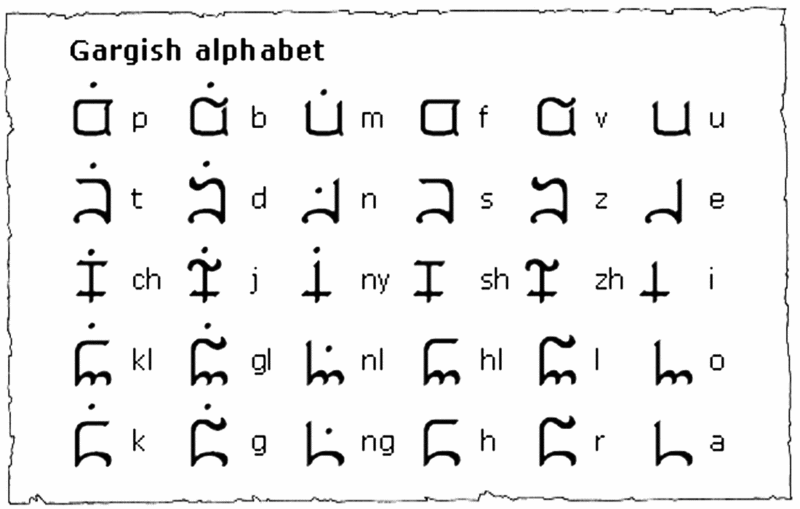
This chart is probably familiar to any Ultima fanatic - the set of runes used to write anything in Gargish. Unlike the Britannian runes, they're always presented in this five-by-six tableau, never in the alphabetic order we English speakers are used to. There's also a good deal more double-character runes in the chart as compared to the Britannian runes. And there's very good reason for both of these facts - like Tolkien's Tengwar script used for the Elvish languages he developed, the Gargish runes form a featural alphabet, a script where the shape of the individual characters is representative of the characteristics of the sound it represents. Each symbol is representative of an individual sound, and the fact the design of the alphabet relies so heavily on the features of the sounds they stand for is what enables one to make a few educated guesses on how the language might sound without hearing a single word of it spoken. Whether they're accurate or not is another thing entirely - there's a whole branch of linguistics devoted to the study of how languages change over time, including phonological shift (English itself had a massive shift in vowel quality over the course of a few centuries, referred to as the Great Vowel Shift), but hey, that's the scientific method, right? Hypothesize, test, compare, adjust.

So let's see what I can do off of this particular data set, so to speak. In order to properly discuss the matter, though, we're going to have to spend some time discussing classification of speech sounds. And in order to do that, I'm gonna pull out a couple more charts for the sake of further visual aids. Allow me to introduce those of you unfamiliar to the International Phonetic Alphabet.


One of the marks of a linguist is the above chart (or similar ones) popping into your head when the acronym "IPA" is uttered, ahead of the beer. Think of it as a sort of standardized notation for the sounds of language. Languages may use the same alphabet, but there's no guarantee that they pronounce each letter the same way. Take the letter J - the French typically pronounce it 'zh,' whereas in German it's more of a 'y'-like sound, neither of which is how it's most often pronounced in English. With IPA, each individual symbol is indicative of one sound and one sound alone - that J becomes /d͡ʒ/ in English, /ʒ/ in French, and /j/ in German. (There's actually a distinction between placing IPA symbols in slashes, like /ʒ/, and between square brackets, [ʒ], but that's a finer distinction than I find necessary for my purposes here.)

The above chart covers most of the consonantal sounds used in the languages of the world. Others exist beyond the ones listed on this particular chart (note the 'pulmonic' descriptor, which doesn't include such things as clicks), but these are essentially the more "standard," and it'll be enough for my analysis. Consonants are distinguished from vowels by a constriction somewhere in the vocal tract, and are described based on what sort of constriction it is and where that constriction is. The labels along the top of the chart indicate the place of articulation - this describes where in the vocal tract the defining obstruction is, such as the lips, the roof of the mouth, or the back of the throat. Down the side list the manner of articulation - how the sound is made around that obstruction, whether it's a full obstruction, forcing air over a partial obstruction, moving it through the nasal cavity instead of the mouth, and so on. And finally, there's a third feature used to describe consonants called voicing, which is basically an indication of what the vocal cords are doing when producing the sound. You can feel the difference by placing your hand on your throat as you make and prolong a 's' and 'z' noise in turn - the buzzing you feel beneath your fingers for the 'z' is the mark of a voiced sound, whereas its absence indicates a voiceless sound. In the chart above, when symbols are paired, the left is voiceless, the right voiced - so /p/ is voiceless, /b/ is voiced.

Vowels are also described by features, though a slightly different set, and as a result, they've got their own chart.


Unlike consonants, there's no obstruction in the vocal tract, which makes the classification of them a bit more nebulous. It's something of a fuzzy line as to where one vowel shifts into another, but generally speaking, vowels are described by the shape of the vocal tract and the location of the tongue to produce the sound. "Backness" describes how far forward in the mouth the tongue is - you can feel the difference between the 'ee' sound (/i/ on the chart) and the 'oo' sound (/u/), the former made closer to the teeth and the latter more toward the uvula. "Height" measures the other direction, and can easily be felt by how open your mouth is when pronouncing the vowel - your mouth is considerably more open when pronouncing the low vowel 'ah' (/ɑ/) as it is when pronouncing the high vowel 'ee' (/i/). And then there's "roundedness", which describes the shape of the lips when pronouncing the vowel in particular. Again, this is easy to feel the difference, as your lips are rounded when pronouncing 'oo' (/u/) as opposed to the unrounded 'ee' (/i/).

So putting all of this together, what have we got in regards to Gargish?

As mentioned before, the table is arranged entirely on the features of the sounds involved - try to ignore the letter transcriptions by each rune, and remember to think of them as sounds. The five rows on the table organize the runes by place of articulation (or backness, for the vowels), moving roughly from the front of the vocal tract to the back. The first row denotes the bilabials and labiodentals (articulated either by both lips or a combination of the lips and teeth), the second the alveolars (made at the roof of the mouth), the third the post-alveolars (just behind the roof of the mouth), and the fifth the velars and glottals (the back of the mouth and the throat). The fourth is a little harder to pinpoint, on account of these particular transcriptions not really representing sounds often used to an English speaker, but I'm inclined to mark these down as palatals, on account of them being between the post-alveolar 'sh' (/ʃ/) and the velar 'k'. At the same time, there's the palatal 'ny' (/ɲ/) in the third row, so it's also possible that these are retroflex sounds, made with the tongue curled back toward the back of the throat. I'm more inclined to call them palatals, as they're closer to the 'kl' and 'gl' the chart gives as a transcription, and perhaps the 'nl' is a retroflex proper (/ɳ/).

The columns, on the other hand, organize the table by voicing and manner of articulation. The first column are the voiceless stops or 'plosives' (sounds involving a complete obstruction), the second the voiced plosives, the third the nasals (where the air moves through the nasal passages rather than the mouth - you can see this for yourself by making an 'm' or 'n' noise and then plugging your nose while doing so), the fourth the voiceless fricatives (where air is passed over a partial obstruction), the fifth the voiced fricatives, and the last the vowels. In addition, affricates - sounds that are a combination of a plosive and a fricative, like 'ch' (/t͡ʃ/) are included in the first and second columns as appropriate, and the liquids or 'approximants', sounds with less of an obstruction than a fricative, are included in the fifth column. These columns are roughly in order of sonority, which is essentially a measure of how resonant they are - I say roughly because nasals are generally more sonorant than plosives or fricatives, and liquids more sonorant than nasals.

So now that we've gone over the general organization of the Gargish alphabet, we can determine a bit more about the quality of the individual sounds. For example, let's examine the Gargish R. The English R is /ɹ/, an alveolar approximant. The Gargish R, however, is enumerated with the bottom row of characters, which makes me more inclined to think of it as the more throaty version used in a language like French or German - either the uvular approximant /ʁ/ or its associated trill /ʀ/. (if you can roll your r's, that's the trill /r/, typically used for the Spanish or Italian R). Then there's the vowels - since U is in the first row, with the most forward sounds, I'm more inclined to think of it as closer to a /ʉ/ or possibly even a /y/ rather than the typical 'oo' (/u/) sound we English speakers are used to. Then there's the dot over the symbols in the first three columns - it's possible that this is a diacritic of sorts, although I'm more inclined to think of it as simply a part of the letter, like the dot over an i or j. However, it does differentiate the bilabial /p/, /b/, and /m/ from the labiodental /f/ and /v/ in the first row, as well as the velar /k/, /g/, and 'ng' (/ŋ/) from the glottal /h/ and the probably-uvular /ʁ/. And if this is the case, it may be indicative of 'frontedness,' which would imply the Gargish /t/ and /d/ to be dentals rather than alveolars, made with the tongue against the back of the teeth rather than at the roof of the mouth and therefore giving it more in common with the Italian T and D rather than the English ones.

We can make a few other conjectures on the nature of Gargish pronunciation by extending analysis to the Gargish vocabulary we have access to - since it's a featural alphabet we're working with, we can draw a few conjectures based off the choice of spelling in certain words. For example, 'summ,' meaning 'honor' - why is this spelled with two 'm's? The presence of double-consonants in the spelling of a language using a featural alphabet suggests to me that the language makes use of what are called 'geminate' consonants - essentially the consonantal equivalent of a prolonged vowel sound. It's something that comes up frequently in Italian - compare /papa/, the Italian word for father, with /pappa/, the word for pope. The latter's a geminate consonant. (Pairs of words like this, that differ in only one sound, are referred to as 'minimal pairs,' and are what's used to identify a speech sound as distinct in the set of speech sounds, or 'phonemic inventory,' that a language uses, rather than simply a variant of another sound used in the language, or an 'allophone.') In addition, take a Gargish word like 'beh' or 'kah' - in an English pronunciation of these words, those h's would probably be silent, but for a language involving a featural alphabet, I'm more inclined to take this as a mark of aspiration, which is a sort of breathyness added to a vowel - if you distinguish the pronunciation of 'witch' from 'which,' then you can hear what I'm talking about. 'Witch' begins with an unaspirated W, whereas 'which' starts with an aspirated W.

There's a couple other things that some more time and perusal of the Gargish vocabulary might suggest to me upon closer inspection, but I think what I've got here is a good taste of what all's involved in my field of choice. How accurate am I with these conjectures? Well, there's... not really a good way for me to tell. Pretty much the only example of spoken Gargish we have in the series is a few bits in Ultima IX, and... well, I don't really think that's enough to go on to do a completely proper phonological analysis, especially considering much of what I've said above is probably a much more in-depth look at the phonological basis of Gargish than was probably meant. At the same time - am I really going to pass up a chance to take a closer look at a fictional language? If nothing else, it gives me a few things to go off of while I practice my Gargish accent!

I mean, I do have a pretty decent microphone. Maybe recording a few practice phrases down the line isn't out of the question?

(For interactive charts - with audio, so you can actually hear the sounds I'm describing! - you can find a pretty good one here. I've only scratched the surface of the ins and outs of phonetics and phonology here, and I'm a huge advocate for Learning New Things! If you find this or other language-analysis topics interesting - or just linguistics in general - hit me up, I can try to point you in the right direction. There's a contact box over to your right, I'd be more than happy to chat.)